
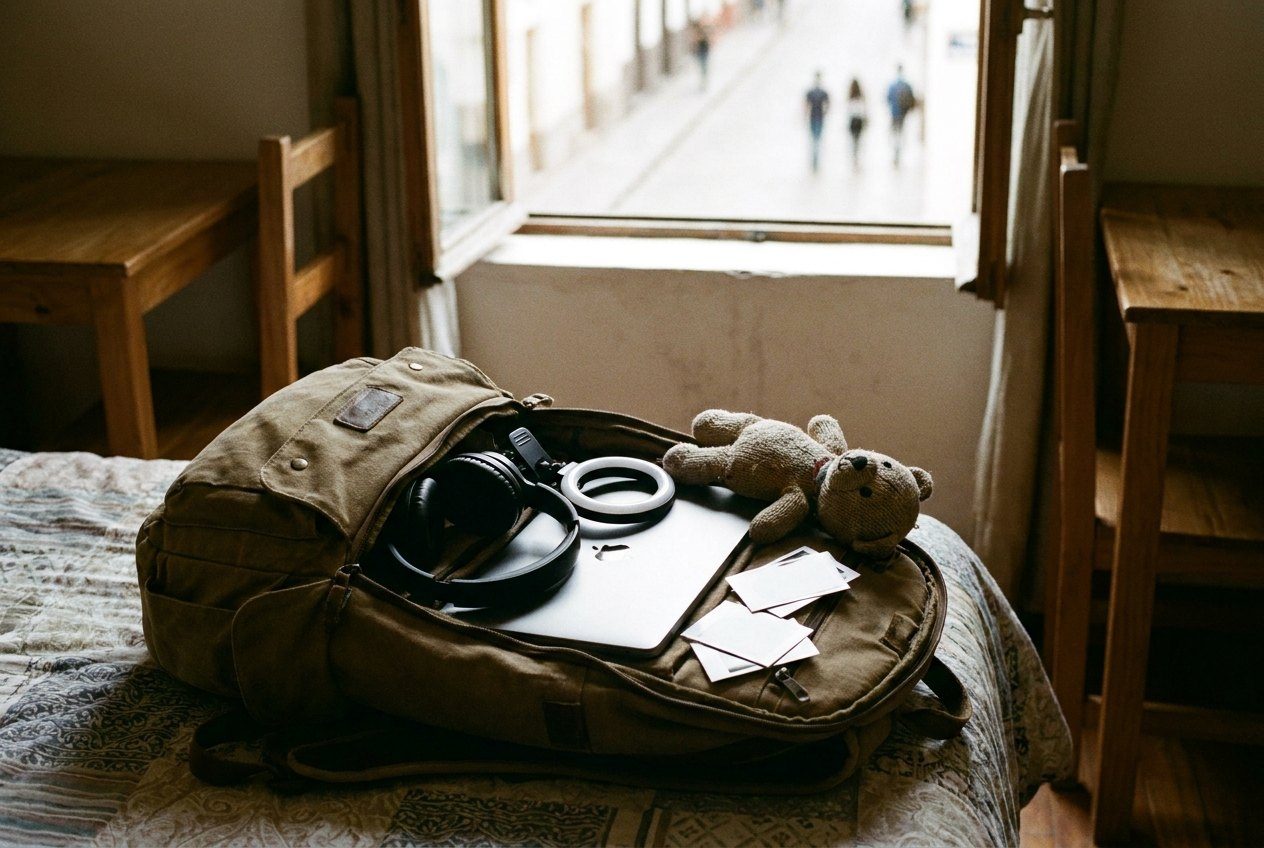
The joy of teaching children online is that your classroom can be anywhere. The catch is that it has to work everywhere: in a guesthouse in the mountains, a city flat with thin walls or a hostel room with one socket. The answer is a small, reliable kit that fits in a backpack and sets up in a few minutes. This guide covers what to carry, what to leave behind and how to build a lesson space from whatever room you find.
The core kit
Start with a laptop that is reliable rather than powerful. Online lessons need a steady video connection, a decent camera and a battery that can carry you through a power cut, not the latest graphics chip. If your laptop camera is poor, a small external webcam clipped to the screen makes a big difference and packs into a sock.
A headset with a microphone is the single most important item. It cuts out echo, keeps background noise down, and means children hear you clearly. Choose one that is comfortable for hours, and carry a spare set of wired earphones with a microphone in case the headset fails mid-lesson.
Light comes next. Children need to see your face and your mouth clearly, especially when you model sounds. A small ring light or a clip-on lamp with a soft white light, placed in front of you rather than behind, solves dark rooms and uneven daylight. Avoid sitting with a bright window behind you; you will turn into a silhouette.
A backdrop that travels
Many families and schools prefer a tidy, cheerful background. You do not need a full wall of posters. A plain piece of fabric, a small folding pinboard or a few cards on a string can turn a hotel wall into a classroom.
- Choose a light, uncrumpled fabric that can hang from a door or curtain rail.
- Add one or two bright items, such as a map, an alphabet strip or a child's drawing of a sun.
- Keep it simple; too many colours distract young learners.
- Check the background in your camera before the first lesson of the day.
Above all, make sure nothing personal or inappropriate is visible behind you, and that the room looks safe and calm.
Power and plugs
Every country has its own sockets, and some rooms have only one. Pack a universal adapter, and a small travel power strip so that one adapter can charge your laptop, phone, lamp and headset together. Most laptop chargers work across the world's voltages, but check the label on every charger before you plug it in, especially for lamps and small electronics.
A power bank that can charge your phone, and ideally your laptop, gives you a buffer during short power cuts. In places where outages are common, ask your host how often the power goes, and whether there is a backup generator.
Turn toFinding internet you can teach onInternet backups
A lesson only works if the connection holds. Always have at least two ways online. The first is the room's own connection, ideally through a cable if your host can offer one, so carry a small ethernet adapter for your laptop. The second is mobile data on your phone, used as a hotspot. Buying a local SIM card or an electronic SIM when you arrive is usually the easiest way to get a reliable plan.
Test both connections before you book long stays, and before every teaching day. Run a test call at the same hour as your lessons, because a connection that is fast at noon may slow to a crawl in the evening. Our guide to finding internet you can teach on goes into detail.
Finding a quiet room
Noise is the hardest thing to control on the road. Roosters, traffic, construction, neighbours and street vendors do not stop for your lesson. When you book a room, ask for one away from the street and away from the kitchen, and look at reviews that mention noise.
A headset helps a lot, as does a soft room with curtains, a rug or a bed that absorbs sound. If your lessons fall at dawn or late at night, think about who sleeps on the other side of the wall. Our piece on how lesson hours land on other continents helps you plan around this.
Props that pack flat
Young learners love props, but you cannot carry a toy box. Choose things that fold, roll or slide into a folder.
- Picture cards and flashcards, ideally laminated so they survive humidity.
- A small whiteboard with a marker and an eraser.
- Finger puppets or one small, soft toy who becomes the class mascot.
- Magnetic or card letters for phonics games.
- A sheet of reward stickers or a simple drawn star chart you hold up to the camera.
A single puppet can carry a whole lesson: it can be shy, make mistakes, ask questions and celebrate correct answers. Our guide to props, puppets and reward systems has more ideas, and phonics for the very young shows how cards and letters can support early reading.
Setting up anywhere
With practice, you can set up your classroom in ten minutes. Find the quietest corner, hang your backdrop, place your lamp in front of you, set the laptop at eye level on a stack of books, plug in your power strip, connect to the internet and run a quick test. Lay out your props within reach, keep water nearby and put your phone on silent.
Then smile, and start the lesson as if you were in a classroom down the road. The children do not need to know where you are; they just need a teacher who is ready.