
Young children learn through things they can see, hold and point at. A picture card of a banana does more than the word written on a board, and a real banana does more than the card. Props give a class something to look at besides the teacher, and they make meaning clear without translation. Rewards, meanwhile, can shape behaviour and build routines, though they need more care than most new teachers expect.
Simple props that do the most
You do not need a cupboard full of equipment. A handful of well-chosen items covers most lessons for young learners, and many of them can be made by hand or found around the house.
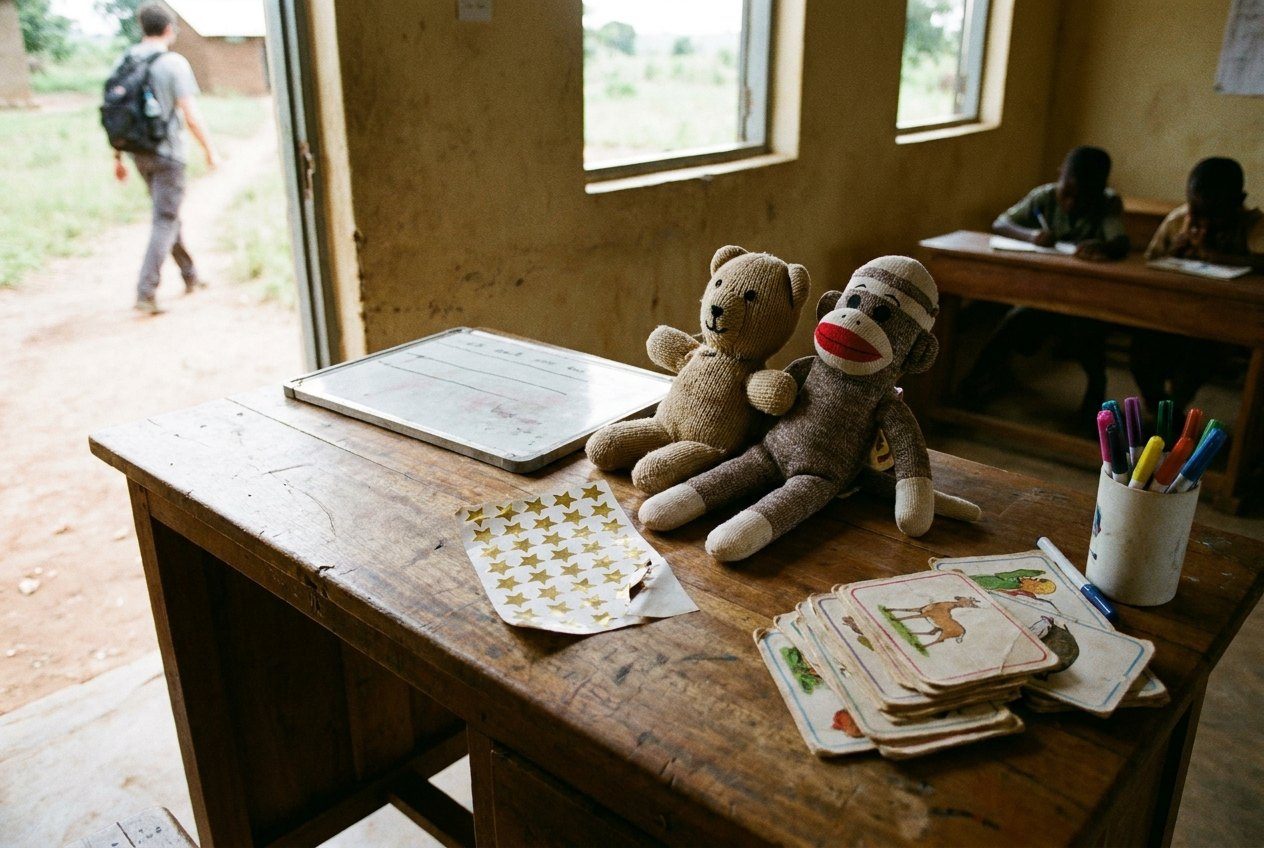
- Picture cards. Clear images on plain backgrounds, large enough to see from the back of a room or through a webcam.
- Real objects. Fruit, toy cars, a hat, a cup, a sock. Children remember the real thing.
- A soft ball. For passing to the next speaker, which makes turn-taking a game.
- A bag or box. Hiding an object and pulling it out slowly turns any word into a small mystery.
- Coloured markers and paper. For quick drawings that explain a word faster than any gesture.
Choose props with care for the setting. Some foods, animals, symbols or gestures carry different meanings in different places, and a colleague can tell you quickly if something might confuse or offend. For teachers on the move, choosing items that fold flat or weigh almost nothing makes packing far easier.
Puppets
A puppet is one of the most useful tools in a young learners' classroom. Children who would never answer the teacher will happily talk to a puppet, correct its mistakes and laugh when it gets confused. A simple hand puppet, a sock with buttons for eyes or a soft toy works just as well as anything expensive.
Give the puppet a name and a small, consistent character. Perhaps it is shy and needs the children to help it speak, or it is forgetful and keeps mixing up colours. The puppet can model a dialogue with you, ask the questions you want the children to answer, or make the deliberate mistakes that let a child feel clever for fixing them. Keep its voice different from yours, even slightly, so children know who is speaking.
Use the puppet sparingly, for a few minutes each lesson, so it stays special.
Drawing boards
A small whiteboard with a marker is a classroom in itself. On it you can draw a quick picture to explain a word, write a letter or a short word in large print, play guessing games where you draw a few lines at a time, or hold up a question for children to answer. In an online lesson, it is often clearer than screen tools, because the child sees your hand moving.
Children can have their own boards in a physical class. Asking everyone to draw or write an answer and hold it up at once lets you check the whole room in a moment, and nobody is put on the spot alone. It suits the slower thinkers who need a few seconds more.
Turn toTotal physical response, and why children love itStickers, charts and points
Most young learners' classrooms use some form of reward. A sticker on a chart, a star on the board, points for a team, a stamp at the end of a lesson. These systems can give a class structure, mark progress that children can see, and make good behaviour visible rather than only noticing mistakes.
They work best when a few rules hold:
- Reward effort and specific actions, such as listening, trying a new word or helping a classmate, rather than only correct answers.
- Make the system simple enough for the youngest child to follow.
- Keep it fair, so every child has a real chance of earning something in each lesson.
- Explain clearly what earns a reward, and stay consistent.
- Follow the school's or family's own approach where one exists, rather than inventing a competing system.
Team points often work better than individual ones in larger classes, because they reduce the sting for any one child and encourage children to help each other. In one-to-one online lessons, a simple chart or a growing picture on screen gives the child a sense of a journey across the lesson.
When rewards help, and when they do not
Rewards are a tool, not a goal. They help most at the start of a course, when routines are new, and with very young children who need concrete signals. They help less as children grow older and begin to enjoy the language for its own sake. A child who only answers to earn a sticker may stop answering when the stickers stop.
Watch for signs that a system has gone wrong: children arguing about points rather than listening, the same few winning every week while others give up, or tears at the end of every lesson over who got the most. When that happens, simplify. Shift towards shared goals, praise that names what the child did well, and the quiet satisfaction of finishing a game or a song.
Never use rewards to shame. Taking points away publicly, comparing children by name or ranking them in front of parents can damage a child's confidence in a language for years. Warm, specific praise costs nothing and works for every age.
Packing props for the road
Teachers who combine online lessons with travel learn to choose props that earn their weight. Laminated cards slip into a folder, a puppet squashes into a corner of a bag, and a small whiteboard can double as a backdrop for letters. Local markets often have toys, fruit and everyday objects that add something new to lessons, and buying a few as you go keeps your materials fresh. For a full kit list, the story on a classroom in a backpack goes through laptops, headsets and lights, and the guide to early phonics shows how picture cards and letter blocks support first reading.