
English spelling has a reputation for being difficult, and it is not entirely undeserved. Yet for the first steps of reading, most of it is regular enough to teach as a system. Phonics is the name for that system: teaching children the sounds that letters and letter groups stand for, and how to put those sounds together to read words. For very young learners of English as a new language, it is usually the bridge between understanding spoken words and decoding them on a page.
Sounds before names
The single most useful principle is to teach what a letter sounds like before what it is called. The letter named "bee" makes a short /b/ sound in words. A child who knows only the name will try to read "bat" as something like "bee-ay-tee", which is not a word at all. A child who knows the sounds can say /b/, /a/, /t/ and hear the word emerge.
Keep each sound short and clean. Many adults add a little vowel to consonants, saying "buh" or "tuh", which makes blending harder. Practise saying /m/, /s/ and /f/ as continuous sounds you can stretch, and /b/, /t/ and /p/ as quick, crisp ones. It feels odd at first but makes a real difference.
A sensible order
There is no single correct sequence, and many programmes differ. A common approach starts with a small group of letters that can make many simple words quickly. A set such as s, a, t, p, i and n is often used, because from those six children can already read words like "sat", "pin", "tap" and "nap". From there, more consonants and the remaining short vowels are added a few at a time.
Whatever order you follow, keep these principles:
- Introduce only a few new sounds each week, with lots of review of the old ones.
- Mix consonants and vowels early, so children can build real words.
- Leave the trickier combinations, such as sh, ch, th and long vowel spellings, until single sounds are secure.
- Follow the school's chosen sequence if it has one, so children are not taught two systems.
Blending and short-vowel words
Blending is pushing sounds together into a word. It is the moment reading clicks, and it can take some children a while. Start orally, without letters: say /c/ /a/ /t/ slowly and ask the child what word they hear. Once they can do that by ear, show the letters and repeat the process.
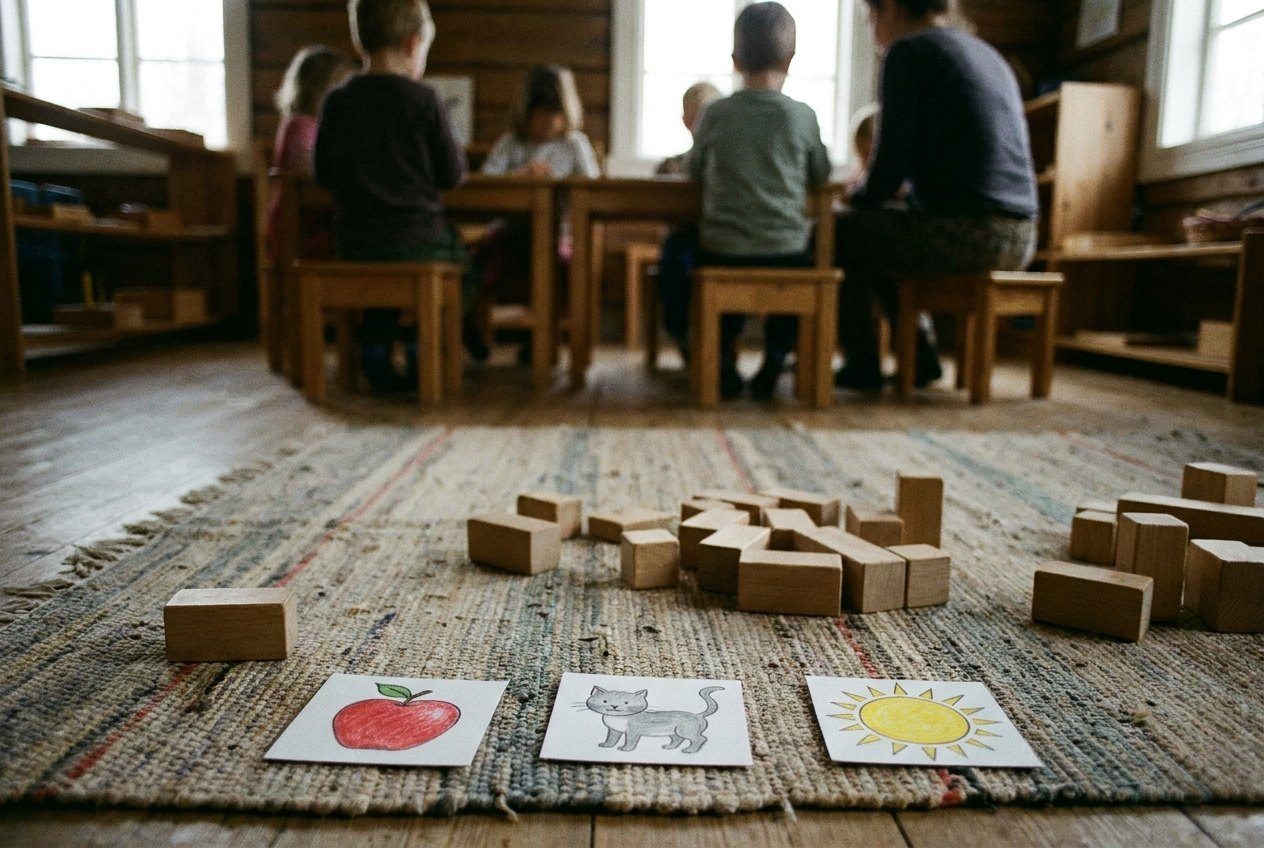
Short-vowel words of three letters, with a consonant, a vowel and a consonant, are the natural starting point. They are regular, there are lots of them, and many name things a young child can picture: cat, dog, sun, bed, pig, hat. Pairing each word with a picture card lets the child check their own reading. If the sounds blend into "pig" and the card shows a pig, the reward is built in.
Segmenting is the reverse skill, breaking a spoken word into its sounds, and it supports early spelling. Clapping or tapping once for each sound in a word turns it into a game.
Turn toTotal physical response, and why children love itSongs, actions and play
Very young children learn sounds faster when sounds come with movement, rhythm and stories. Many phonics approaches pair each sound with a simple action: a snake shape for /s/, tapping fingers for /t/, puffing out a candle for /p/. These link naturally with total physical response, where every new word has a gesture.
Short songs that repeat a sound, tongue twisters slowed right down, and spotting games for things beginning with /m/ all keep phonics practice light. Letter blocks or magnetic letters let children build and change words with their hands, swapping the middle letter of "cat" to make "cot" and "cut". Simple picture cards and props, of the kind covered in the story on props and puppets, are a natural partner.
Keep sessions short. Ten focused minutes of phonics within a lesson is usually more effective with four and five year olds than a long block, and finishing while they still want more is better than finishing when they are tired.
Sounds that do not exist at home
Every language has its own set of sounds, and some English ones will be new to your learners. The "th" sounds are absent in many languages. Speakers of Japanese and Korean often find /l/ and /r/ hard to tell apart, because their languages do not separate them the way English does. Spanish speakers may hear /b/ and /v/ as one sound. Short vowels such as those in "ship" and "sheep" can sound the same to many learners.
This is not a weakness in the child. It is how every human brain tunes itself to its first language, and English speakers struggle in exactly the same way with sounds from other languages. Patience matters far more than correction. Model the sound clearly and often, show the shape of your mouth, and let the child hear the difference in pairs of words before you expect them to say it. Praise the attempt, not only the result.
The goal is clear, confident communication, not a particular accent.
Teaching phonics on screen
In online lessons, close-ups do the work. Hold letter cards near the camera, show your mouth clearly when making a sound, and slow down so lag does not blur the sound. A small whiteboard lets you write and rub out letters as you build words together. Ask the child to show you their own letters or point to a card, so the lesson stays two-way.
Parents often sit in on lessons for young children and may want to help between classes. A short note on the sounds covered and one or two words to practise gives them a clear role without turning home into a second school. Phonics grows with steady, gentle repetition, and a few minutes a day at home can matter as much as the lesson itself.
Bell rings: back to this unit.